Commercial
Submarines
Submarines
Silvercrest Submarines supplies commercial manned submersibles rated from 150 metres to 366 metres (1,200ft) and beyond, for offshore inspection, diver lockout, salvage, and deep-water intervention worldwide.
Pioneer Submersible – ABS-Classified 1,200ft Commercial Work Platform

TAURUS Multi-Purpose Deep Submergence Rescue Vehicle

Perry PC18 Diver Lockout Submersible
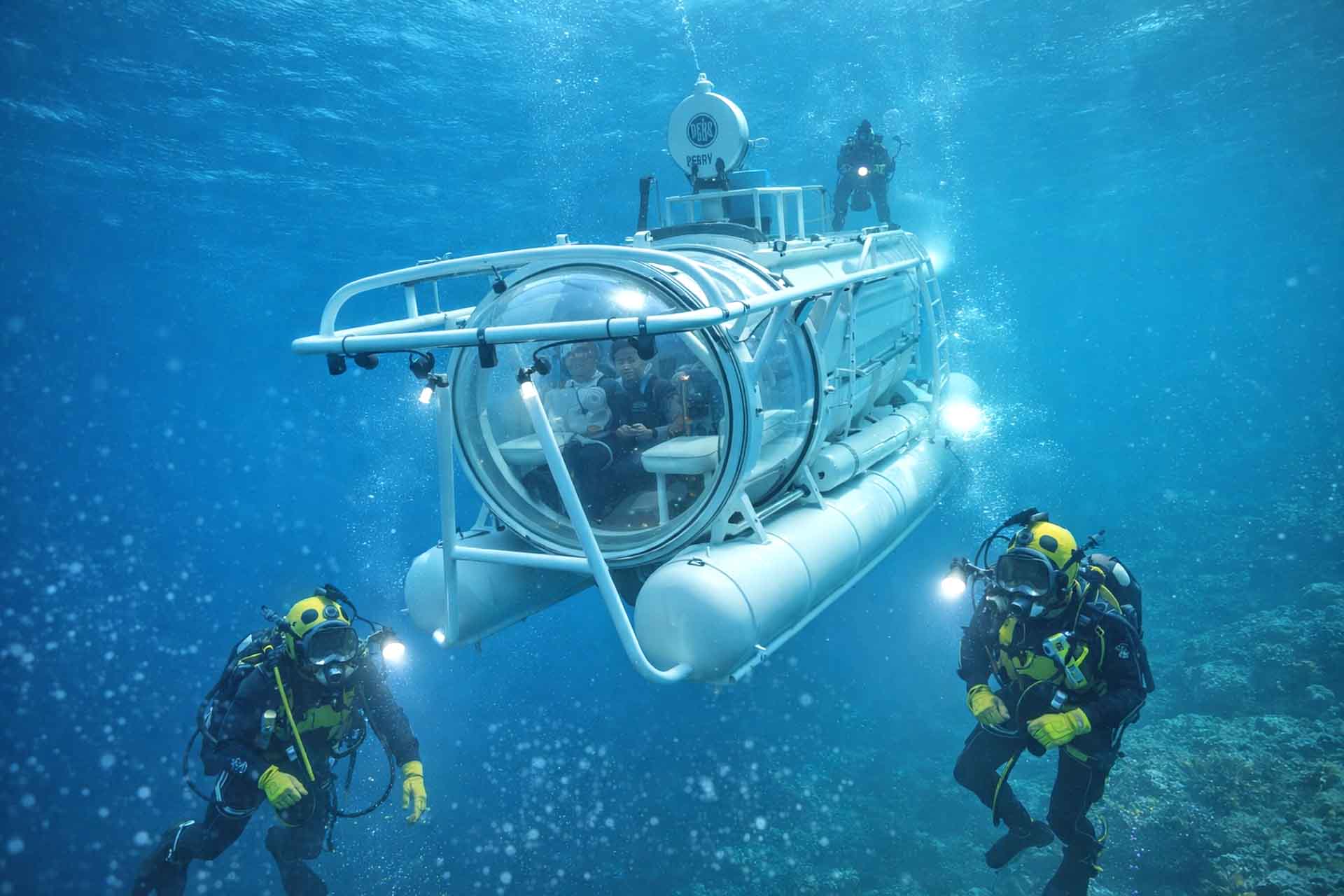
Perry PC-14 “Ulysses” – 4 Passenger One-Atmosphere Observation Submersible

Deep-C SEAmagine Ocean Pearl 2 Person 1,000ft Submersible

Underwater Bar & Restaurant – Mobile Entertainment Complex
Get In Touch
Commercial submarines occupy a distinct and demanding position within the broader manned submersible market. These are professional work platforms — engineered not for passenger comfort or leisure, but for operational effectiveness at depth in some of the most challenging subsea environments on earth. Silvercrest Submarines’ commercial inventory spans one-atmosphere observation and inspection platforms, diver lockout submersibles, and deep submergence rescue vehicles (DSRVs), with depth ratings from 150 metres for coastal inspection work through to 366 metres (1,200ft) for offshore applications, and specialist systems capable of operating at 610 metres (2,000ft) and beyond. Each platform in this category has a specific operational purpose, and matching the right platform to the right task is precisely where Silvercrest Submarines’ three decades of commercial experience proves its value.
Operational Capacity and Applications
Commercial submarines are defined by their ability to place a trained operator — or a working diver — at depth, and to support productive activity once there. Platform configurations within Silvercrest Submarines’ inventory reflect this operational breadth. One-atmosphere systems carry a pilot and, in some configurations, an observer or scientist, maintaining surface pressure throughout the dive. These platforms are suited to pipeline inspection, infrastructure survey, offshore site assessment, and scientific data collection across continental shelf environments. The Deep-C SEAmagine Ocean Pearl, rated to 305 metres (1,000ft) and configured for a two-person crew, represents this class of capable, compact inspection submersible.
Diver lockout submersibles serve a fundamentally different operational requirement. The Perry PC18 — a proven platform within Silvercrest Submarines’ commercial inventory — allows the crew to transit to depth under atmospheric pressure before a diver exits through a wet lockout chamber to carry out intervention work in the surrounding environment. This configuration is particularly well suited to tasks requiring a human operator’s dexterity at depth: fastening and releasing components, retrieving small objects, or undertaking inspection tasks in confined spaces where manipulator arms cannot reach. The TAURUS multi-purpose DSRV, rated to 366 metres (1,200ft) and carrying up to six passengers alongside a crew of two, offers exceptional flexibility for rescue, research, and commercial conversion roles. The compact European-built Com-Sub, rated to 150 metres, provides an efficient and cost-effective entry point for coastal commercial inspection programmes.
Primary application sectors include offshore oil and gas — encompassing pipeline inspection, wellhead survey, and infrastructure integrity assessment across the North Sea, Gulf of Mexico, and Asia-Pacific offshore fields — alongside commercial salvage, underwater construction support, and specialist research programmes requiring a manned presence at depth. The ability to position a human observer or operator precisely, with real-time decision-making capacity, remains a distinct advantage over ROV operations in tasks where adaptability matters.
Business Solutions and Market Position
The commercial submarine market serves a professional buyer. Offshore energy operators, commercial diving companies, pipeline contractors, and salvage firms are not acquiring a lifestyle asset — they are making a capital investment in operational capability that needs to generate a return. The commercial case for manned submersible ownership typically rests on the ability to internalise a capability currently contracted out at day-rate, to strengthen a tender submission with owned assets rather than hired-in equipment, or to establish a vertically integrated offshore service with a demonstrable technology edge.
Silvercrest Submarines supports buyers across the full acquisition spectrum. Outright purchase of a pre-owned certified platform offers the fastest route to operational capability for operators who can absorb capital expenditure. Charter arrangements allow companies to deploy a commercial submarine on specific projects without the ongoing overhead of ownership — a practical model for organisations with periodic rather than continuous operational requirements. For operators seeking a new-build solution, Silvercrest Submarines can facilitate manufacture to specification, with appropriate classification society involvement from the outset. In each case, the buying decision is informed by Silvercrest Submarines’ operational experience — not by equipment sales targets. Serious buyers are invited to discuss their programme requirements in detail before any platform is recommended.
Engineering and Safety Standards
Commercial submarines operate within a rigorous regulatory and certification framework that is fundamentally different from leisure craft or tourist submarine regulation. Classification societies including the American Bureau of Shipping (ABS), DNV GL, and Lloyd’s Register each define structural, mechanical, electrical, and operational standards that a commercial submersible must meet and maintain throughout its operational life. The ABS-classified Pioneer Submersible and the TAURUS DSRV are examples within Silvercrest Submarines’ inventory of platforms carrying recognised classification credentials — a requirement for insurance, offshore operator acceptance, and regulatory compliance in most international jurisdictions.
Annual survey and periodic special survey cycles govern the certification status of commercial submersibles. These cycles cover pressure hull integrity, viewport and penetrator condition, life support system function, thruster and propulsion systems, and emergency systems including drop weights, buoyancy systems, and communication equipment. For operators procuring a pre-owned platform, understanding the current survey status and any outstanding items is essential — and Silvercrest Submarines’ technical team can assist qualified buyers in conducting or commissioning a proper pre-purchase technical assessment. Certification is not merely a regulatory formality: it determines whether a platform can be insured, operated commercially, and accepted by offshore energy operators under their own contractor management systems.
Global Manufacturing and Support
Silvercrest Submarines’ commercial submarine support capability extends beyond the point of sale. Pilot training is delivered by operators with genuine commercial submersible experience — individuals who have conducted inspection programmes, supported research expeditions, and managed real-world operational challenges, rather than instructors whose background is solely academic or manufacturing-based. This operational foundation is particularly relevant for organisations fielding a commercial submarine programme for the first time, where the gap between equipment acquisition and genuine operational readiness can be considerable.
For platforms requiring refurbishment, system upgrades, or classification reinstatement, Silvercrest Submarines can coordinate technical work through established engineering partnerships worldwide. Spare parts sourcing, maintenance schedule development, and surface support vessel configuration advice are all areas where Silvercrest Submarines’ practical experience adds value beyond the transaction. Operators based in the North Sea region, the Gulf of Mexico, or Asia-Pacific offshore markets will find that Silvercrest Submarines’ international network supports deployment across all major offshore regions. New-build enquiries for commercial platforms should allow for appropriate lead times, which vary by platform specification and classification society involvement.
Why Silvercrest Submarines
Most submersible suppliers operate either as manufacturers promoting their own product range, or as brokers with limited operational knowledge of the equipment they are selling. Silvercrest Submarines occupies a different position entirely. Over three decades of operational experience — encompassing commercial pipeline inspection contracts, BBC natural history documentary filming aboard manned submersibles, and extended research operations including the Loch Ness expeditions — means that Silvercrest Submarines understands commercial submarine operations from the inside. That operational credibility shapes every aspect of how the company advises buyers: which platform genuinely suits the programme, what the realistic costs and infrastructure requirements are, and where the risks lie in both acquisition and operation.
Commercial submarine acquisition is a significant decision with long-term operational and financial implications. Qualified operators are invited to contact Silvercrest Submarines through the enquiry form to discuss programme requirements, platform availability, and the most appropriate acquisition or charter route for their specific application.