Atmospheric
Diving
Suits
(ADS)
Diving
Suits
(ADS)
Atmospheric Diving Suits are one-person armoured submersible systems that maintain surface atmospheric pressure around the operator at depth – eliminating decompression entirely. Silvercrest Submarines offers two ADS units for sale: the Spider, rated to 610 metres (2,000ft) and certified by Lloyd’s Register, and the Wrangler, rated to 400 metres (1,200ft). Both are tethered, self-propelled systems equipped with articulated manipulator arms, lights, and cameras – suited to deep intervention, close-up inspection, and tasks requiring direct physical access at depth.

Get In Touch
What Is An Atmospheric Diving Suit?
An Atmospheric Diving Suit is, in effect, a wearable one-atmosphere submersible. The operator works inside a rigid, articulated suit that maintains normal surface pressure regardless of operating depth — there is no nitrogen narcosis, no oxygen toxicity risk, and no decompression obligation on ascent. The result is a system that combines the direct access and physical capability of a diver with depth ratings that conventional saturation diving programmes struggle to match economically. For classification and regulatory purposes, ADS units are rated as manned submersibles, not conventional diving equipment, and both systems in the Silvercrest Submarines inventory have been certified by recognised classification societies accordingly.
What an Atmospheric Diving Suit Can Do
The defining advantage of an ADS over a conventional submarine or ROV is the ability to physically interact with the environment at depth. Articulated manipulator arms allow the operator to grip, manipulate, sample, and work on structures directly — tasks that are beyond an observation-only submarine and that require considerably more complex tooling packages when attempted with a work-class ROV. At the same time, the suit’s propulsion system allows the operator to approach, reposition, and withdraw under their own power, rather than being constrained by the reach of a crane or the positioning accuracy of a vessel above.Typical applications include deep structural inspection where close-up physical access is essential, subsea intervention tasks where a manipulator arm must be applied with precision, cable and pipeline survey and assessment, search and recovery operations, and wreck survey work requiring direct documentation at depth. The ADS operator sees the environment directly through a viewport, making real-time decisions that no remote system can fully replicate.
Spider ADS — 610 Metres (2,000ft)
The Spider was built by Slingsby Engineering Limited in England and is certified by Lloyd’s Register of Shipping. It is rated to 610 metres (2,000ft) and propelled by six hydraulic thrusters with independently variable, infinitely adjustable speed — giving the operator precise control in all axes. Two articulating arms with powered hydraulic claws provide genuine intervention capability. A large domed viewport gives broad situational awareness, supported by powerful external lighting and continuous live video transmission to the surface. A suction pad anchor system allows the operator to hold station on structures or seabed without thruster activity, which is particularly useful during detailed inspection or manipulation tasks. Life support endurance is 72 hours. The Spider is deployed via a compact handling system suitable for small vessels, drill rigs, and offshore platforms, making it deployable to remote sites without specialist support infrastructure.
Wrangler ADS — 400 Metres (1,200ft)
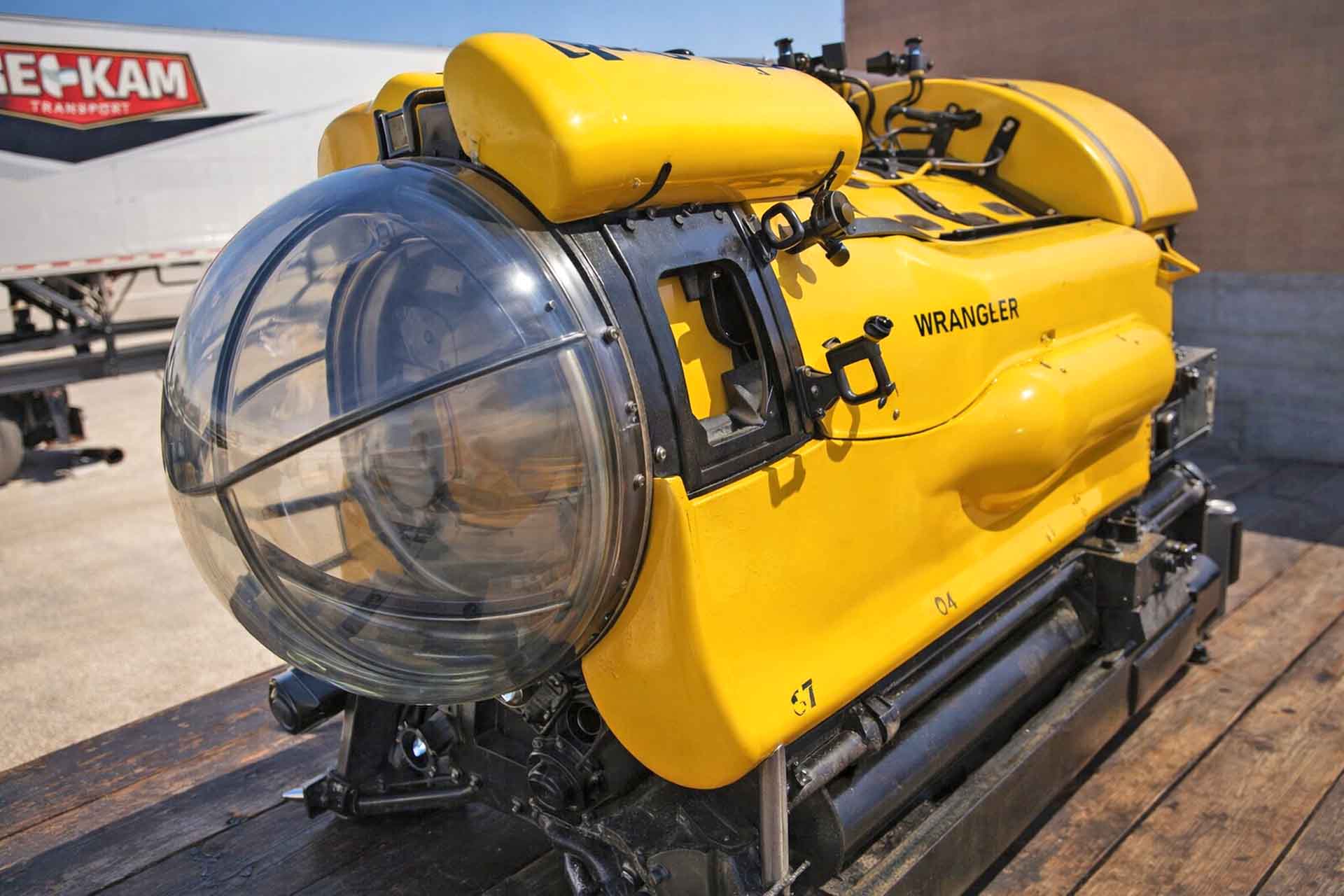
The Wrangler was built in Canada by ISE and is a lightweight tethered system with two large acrylic viewports, a manipulator arm, external lighting, and surface communications. Weighing 1,500kg, it is transportable and operable from a wide range of vessels. Current certification is to 400 metres (1,200ft), with potential recertification to 610 metres (610m) subject to survey. Both units are powered via a combined lifting and electrical umbilical from the surface vessel, which also carries the live video feed and communications link. The Wrangler requires a minor refit prior to dive operations.
Operational and Regulatory Context
Atmospheric diving suits occupy a distinct regulatory and operational space. Because they maintain one atmosphere internally, the operator requires no decompression and can return to the surface immediately in an emergency — an important operational safety advantage over saturation diving. Classification as manned submersibles means that both the system and its operations are governed by the same professional frameworks that apply to conventional submersibles, including Lloyd’s Register certification for the Spider. Silvercrest Submarines has direct operational experience with ADS systems and can advise on deployment logistics, handling system requirements, and operational protocols from first-hand knowledge rather than simply as equipment suppliers.
Why Silvercrest Submarines for ADS
Silvercrest Submarines does not simply broker equipment — the company has operated atmospheric diving suits in the field and understands the practical considerations that distinguish a successful ADS programme from a theoretical one. Advice on vessel compatibility, handling system design, umbilical management, and operator familiarisation is grounded in over three decades of manned submersible operations across commercial, scientific, and professional diving applications worldwide. Both the Spider and Wrangler are available for purchase. Qualified operators are invited to make a detailed enquiry via the on-page form.